
Legal
New Lawdistrict analysis finds 574 AI-hallucinated court cases in six months—raising the stakes for verification in U.S. filings

Houston, TX / 500NewsWire / September 28, 2026 / AI tools are now part of everyday legal work, from drafting and summarizing to organizing research. The problem is that “helpful” output can look courtroom-ready even when it’s wrong—complete with case names, pinpoint cites, and quotes that never existed.
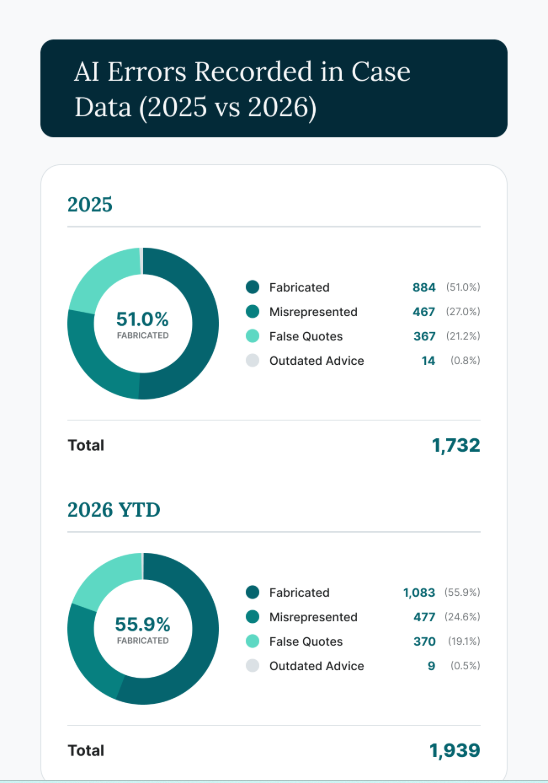
LawDistrict’s latest research tracks a sharp rise in documented U.S. court decisions that flag AI-generated hallucinations, including fabricated citations and misquoted authority. The full report and methodology are available here: AI-hallucinated court cases.
The headline number: 574 documented cases in six months
According to LawDistrict’s analysis of publicly documented decisions, U.S. courts logged 574 AI-hallucination-related cases in just the first half of 2026—more than the total recorded during all of 2025.
Based on the current pace, LawDistrict projects roughly 1,200–1,300 such cases by year-end 2026. Under a higher-growth scenario, the estimate rises further—underscoring how quickly this issue can move from “rare mistake” to routine risk management.
2023: 11 cases recorded
2024: 37 cases recorded
2025: 526 cases recorded
- First half of 2026: 574 cases recorded
What the errors look like in real filings (and why they’re hard to spot)
Not all hallucinations are obvious. Some are easy to catch—like a case that doesn’t exist. Others are more dangerous because they blend truth with fiction, attaching false language to real decisions or misstating what a real case held.
In the dataset referenced in the LawDistrict report, the most common issues were:
Fabricated citations: made-up cases, docket numbers, or reporters
Misrepresented real cases: real authority, wrong holding
- False quotations: invented quotes attributed to real judges
Lawdistrict highlights how one fabricated quote wrongly attributed to Justice Antonin Scalia was used by a federal judge to open a sanctions order, illustrating how authoritative-sounding output can slip into the record before anyone realizes it needs checking.
Who’s getting caught: not just lawyers
The report points to a pattern courts are increasingly seeing: AI-related citation problems appear frequently in filings by unrepresented litigants, but they also show up in attorney submissions especially where review resources are thin.
One practical takeaway is that the risk isn’t limited to one “type” of filer. It’s strongly tied to whether there is a verification safety net: a second reader, a formal cite-check, or a workflow that treats AI output as a draft rather than a source.
“Many don’t count properly the blessings of working in big teams where eventually someone checks and catches those issues.”
—Damien Charlotin, Senior Research Fellow (HEC Paris), creator of the AI Hallucination Cases Database
Courts are responding—but the consequences are inconsistent
One of the most important findings isn’t only that the case count is rising. It’s that penalties vary widely. Similar-looking mistakes can lead to anything from a warning to significant financial sanctions, suspensions, or referrals to state Bars.
Lawdistrict’s report describes the overall enforcement landscape as uneven, with monetary sanctions in recorded cases now exceeding $1.15 million and some matters resulting in six-figure totals. But the bigger issue for practitioners is predictability: teams often can’t reliably tell in advance how a court will react.
That inconsistency matters because it shifts the calculation from “Will this be caught?” to “What happens if it is?”and the answer depends heavily on the judge, the jurisdiction, and whether the filer corrects the record promptly.
What teams can do today: treat verification as a filing requirement
LawDistrict’s analysis is blunt on a point many legal teams are learning the hard way: model improvements alone won’t eliminate hallucinations. That means the workable solution is procedural, not aspirational.
For legal professionals and self-represented filers alike, the most defensible approach is to build a verification step that is as routine as proofreading:
Verify every citation in a trusted database before filing.
Pull the primary source (the actual opinion/order), not a summary.
Confirm quotations match the text and context.
- Correct fast and transparently if an error is discovered.
For background on responsible AI use and broader policy work, readers may also consult resources from the National Institute of Standards and Technology (NIST), the Federal Judicial Center, the U.S. Supreme Court, and the American Bar Association’s technology resources.
Availability
Lawdistrict’s full analysis, including methodology, projections, and examples of how courts have described AI-generated errors in orders and sanctions decisions, is available online.
Read the report: LawDistrict, “574 Hallucinated Court Cases in Six Months: Should We Be Worried?” (Last updated September 07, 2026)
Closing note
The most sobering part of the data isn’t that AI can be wrong, lawyers already know that every tool has failure modes. It’s that the mistakes are often plausible, formatted like legal authority, and increasingly costly once they enter the court record.
As this trend accelerates, the practical conclusion is simple and actionable: if AI touches a filing, manual verification can’t be optional, it has to be part of the filing process.
Media/Press Contact: LawDistrict Team Website: https://www.lawdistrict.com/