
Business
Freedom Forever Bankruptcy: CredibleLaw Explains Homeowner Options as October 16, 2026 Claim Deadline Nears
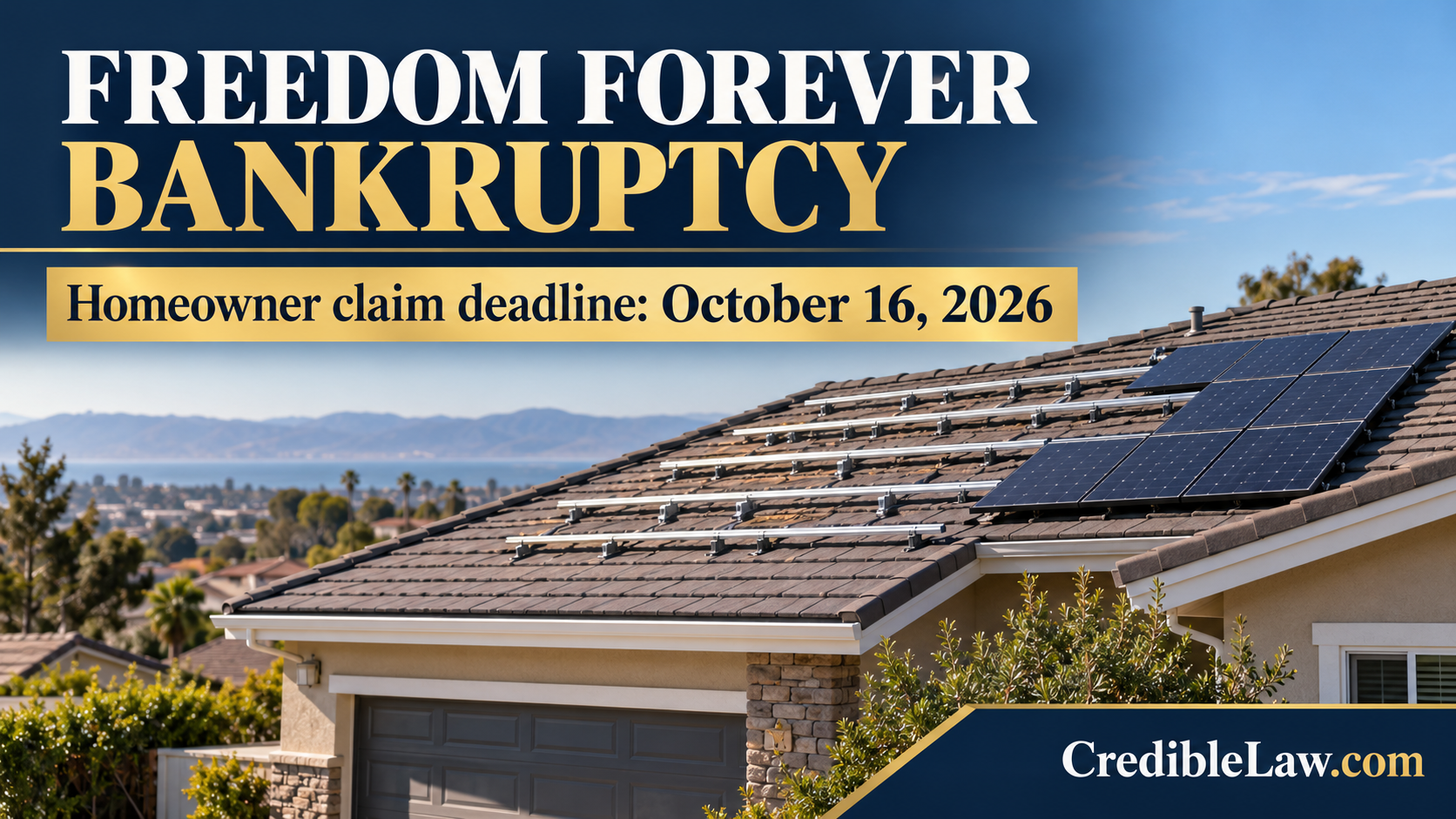
New CredibleLaw guide explains what Freedom Forever solar customers may still owe on loans, leases, and PPAs, how the FTC Holder Rule works, and how to file a proof of claim in the Chapter 7 case.
SAN DIEGO, CA / 500NewsWire / September 30, 2026 / CredibleLaw, a national legal resource and attorney referral network, today published a homeowner guide to the Freedom Forever bankruptcy, one of the largest residential solar installer failures in the United States. The guide, Freedom Forever Bankruptcy: What Homeowners With Unfinished or Inactive Systems Can Do, explains what customers may still owe, who now controls their projects, and how to protect their rights before the October 16, 2026 deadline to file a proof of claim in the company's bankruptcy case.
Freedom Forever LLC filed for Chapter 11 bankruptcy on April 15, 2026, in the U.S. Bankruptcy Court for the District of Delaware (Case No. 26-10522). On August 7, 2026, the case was converted to a Chapter 7 liquidation after no qualified buyer emerged, and a Chapter 7 trustee was appointed to wind down the company. Freedom Forever held about 6.1 percent of the U.S. residential solar market in 2025, second only to Sunrun, according to published industry reports. Solar Power World has reported that more than 150,000 homeowners had Freedom Forever systems installed.
For many of those homeowners, the bankruptcy has created a practical problem: panels that were installed but never connected to the grid, installations left unfinished, and loan or lease bills arriving for systems that have not produced power. One Tampa homeowner told local reporters that his system, installed in March 2026, was still not connected months later, while lease payments were scheduled to begin in September.
Key Facts: The Freedom Forever Bankruptcy Case
| Item | Details |
|---|---|
| Debtor | Freedom Forever LLC (with two affiliates that filed May 2, 2026; jointly administered) |
| Court | U.S. Bankruptcy Court for the District of Delaware |
| Case number | 26-10522 |
| Chapter 11 filing | April 15, 2026 |
| Converted to Chapter 7 | August 7, 2026 |
| Proof of claim deadline | October 16, 2026 (general creditors, as reported; confirm on the official case notice) |
The October 16 date is consistent with the Federal Rules of Bankruptcy Procedure. When a case converts to Chapter 7, a new 70-day period for filing proofs of claim begins (Rules 1019(2) and 3002(c)), and 70 days after August 7, 2026, is October 16, 2026. Homeowners should confirm the deadline on the notice issued in the case, because the court controls it.
Do Freedom Forever Customers Still Have to Pay Their Solar Loan or Lease?
In most cases, the answer is yes, at least initially. Freedom Forever was the installer. Homeowners typically paid for their systems through a separate company: a solar lender for a loan, or a leasing company or investor for a lease or power purchase agreement (PPA). Because those companies are not in bankruptcy, Freedom Forever's filing does not by itself cancel the homeowner's loan, lease, or PPA.
That does not mean homeowners are without options. According to the CredibleLaw guide, the answer depends on the type of contract and the status of the project:
Loan, system unfinished or never turned on: The lender may be subject to the homeowner's claims against Freedom Forever under the FTC Holder Rule, discussed below.
Lease or PPA, system not operating: Many agreements tie the first payment to an "in-service" date, commencement date, or utility permission to operate. PPA charges are typically based on power actually produced.
Deposit or cash paid, work not done: The homeowner may have a claim against Freedom Forever's bankruptcy estate and would generally need to file a proof of claim.
The guide cautions against simply stopping payments. Missed payments can damage credit, lead to collection activity, and weaken a homeowner's position. Written disputes, regulator complaints, and a review of the contract are generally safer first steps.
Who Controls a Stranded Freedom Forever Project?
Trade press coverage of the case reports that the bankruptcy court authorized several finance companies to resume and complete stranded Freedom Forever installations. For an individual homeowner, the question is which company holds their contract. The guide recommends checking the loan agreement or Truth in Lending disclosure, recent billing statements, any UCC fixture filing recorded with the county, and the utility's record of the interconnection application. Homeowners can also ask the lender or leasing company, in writing, who is responsible for completing the installation and obtaining permission to operate.
The FTC Holder Rule: Holding a Solar Lender Responsible
For loans arranged through the installer, the Federal Trade Commission's Holder Rule (16 C.F.R. Part 433) may be the most important protection available. The rule requires seller-arranged consumer credit contracts to state that any holder of the contract "is subject to all claims and defenses which the debtor could assert against the seller." In practice, that can allow a homeowner to raise the installer's failure to finish the work against the lender that now holds the loan.
The rule has limits. Recovery against the lender is capped at the amount the borrower has paid under the loan, although the rule can also be used defensively. It applies to consumer credit contracts, so its reach to leases and PPAs is far less certain. Courts are also divided on what happens when a required notice is missing from the contract. CredibleLaw's FTC Holder Rule guide for solar loans explains how the rule works and how homeowners have used it after an installer disappears.
Lease and PPA Payments and Permission to Operate
Permission to operate (PTO) is the utility's approval to connect and run a solar system. For lease and PPA customers whose systems never received PTO, the key question is when payments were supposed to begin under the contract. The guide advises homeowners to look for terms such as "in-service date," "commencement date," or "placed in service," and to review any production or uptime guarantee.
Some states address payment timing directly. Arizona law bars lease payments until the system is energized, interconnected, and granted permission to operate (A.R.S. 44-1763). Nevada limits what a buyer must pay the installer beyond a deposit until the utility grants permission to connect, for purchase agreements signed on or after October 1, 2025.
How to File a Proof of Claim in the Freedom Forever Bankruptcy
A proof of claim notifies the bankruptcy court that the debtor owes the claimant money. In a Chapter 7 case, a creditor generally must file one for the claim to be allowed (Bankruptcy Rule 3002(a)). Homeowners may have claims for deposits paid for work never performed, payments made for unfinished installations, damage caused by an installation, or unpaid refunds.
Form: Official Form 410, available from the U.S. Courts website, filed according to the instructions in the case notice.
Already filed? A proof of claim filed before the August 7, 2026 conversion is treated as filed in the Chapter 7 case (Bankruptcy Rule 1019(4)), so homeowners do not need to file again.
Deposit priority: Individuals who paid a deposit for household goods or services that were never provided may be entitled to priority up to $3,800 under 11 U.S.C. § 507(a)(7), as adjusted April 1, 2025.
Documentation: Contracts, receipts, invoices, photos, and correspondence supporting the amount claimed.
The guide is candid about recovery. In a Chapter 7 liquidation, secured and priority claims are paid first, and general unsecured creditors often receive a small percentage or nothing. For many homeowners, the lender or leasing company, which is not protected by the bankruptcy's automatic stay, is the more practical source of relief. Filing on time preserves the homeowner's rights against the estate.
Florida and Texas: State Law Considerations
In Sun Belt states where Freedom Forever operated heavily, state law can add protections:
Florida: The state's distributed energy statute (F.S. 520.20 to 520.26) requires written disclosures to solar buyers, including the installer's license number, total costs, savings assumptions, and a right to rescind of at least three business days. For willful violations, F.S. 520.25 allows recovery of finance charges and fees paid, plus attorney's fees and costs. Florida's Homeowners' Construction Recovery Fund may pay up to $30,000 on eligible claims against contractors licensed under Part I of Chapter 489, for contracts signed on or after July 1, 2024.
Texas: For contracts signed on or after September 1, 2025, the Residential Solar Retailer Regulatory Act (Texas Occupations Code chapter 1806) provides five business days to cancel and requires contracts to include a loan-cancellation provision when the lender was affiliated with or referred by the retailer. The Texas Deceptive Trade Practices Act awards attorney's fees to a prevailing consumer.
Rules differ widely across the country. CredibleLaw's comparison of solar contract laws by state covers cancellation windows, solar disclosure statutes, licensing, and consumer remedies in 15 states, each cited to the statute or rule.
"When an installer as large as Freedom Forever is liquidated, thousands of homeowners are left asking the same questions: Do I still have to pay, who is going to finish my system, and what happens to the money I already paid," said SPOKESPERSON of CredibleLaw. "Our goal with this guide is to lay out the facts from the case record and the law in plain language, so homeowners can understand their options and make informed decisions before the claim deadline." |
Steps Freedom Forever Customers Can Take Now
Save all records, including contracts, disclosures, permits, inspection reports, monitoring data, and payment history.
Identify the company that holds the loan, lease, or PPA, and the servicer collecting payments.
Check project status with the utility (interconnection) and the local building department (permits and inspections).
Dispute bills for an unfinished or inactive system in writing, and keep proof of delivery.
File a proof of claim by October 16, 2026, if Freedom Forever owes money.
File complaints with the state attorney general, the contractor licensing board, and, for loans, the Consumer Financial Protection Bureau.
Avoid paying large upfront fees to "solar cancellation" services without confirming whether a licensed attorney is involved.
Frequently Asked Questions
Did Freedom Forever file for bankruptcy?
Yes. Freedom Forever LLC filed for Chapter 11 on April 15, 2026, in the U.S. Bankruptcy Court for the District of Delaware (Case No. 26-10522). The case converted to Chapter 7 liquidation on August 7, 2026.
What is the Freedom Forever claim deadline?
The reported deadline for general creditors to file a proof of claim is October 16, 2026, consistent with the 70-day period that begins when a case converts to Chapter 7. Homeowners should confirm it on the official case notice.
Do I still have to pay my solar loan after Freedom Forever's bankruptcy?
Generally yes, because the lender is a separate company. If the system was never finished or turned on, the FTC Holder Rule may allow the homeowner to raise Freedom Forever's failures against the lender, up to the amount paid on the loan.
Does the bankruptcy stop claims against lenders or leasing companies?
No. The automatic stay generally protects Freedom Forever, not separate lenders or leasing companies.
The full guide, with key dates, a situation-by-situation table, step-by-step instructions for filing a claim, and cited sources, is available at CredibleLaw's Freedom Forever bankruptcy guide for homeowners.
About CredibleLaw
CredibleLaw is a national legal resource and attorney referral network headquartered in San Diego, California. It publishes plain-language legal information on consumer protection, solar contracts, business finance, and other practice areas, and connects consumers and businesses with independent, licensed attorneys. CredibleLaw is not a law firm and does not provide legal advice or representation. CredibleLaw is not affiliated with Freedom Forever, its bankruptcy trustee, or any lender or leasing company. Contacting CredibleLaw does not create an attorney-client relationship. This release summarizes public case information and published reports as of September 29, 2026, and is not legal advice; homeowners should consult a licensed attorney about their specific situation.
Media Contact:
CredibleLaw
160 Thorn St, San Diego, CA
Phone: 888-201-0441
Email: [email protected]
Website: https://crediblelaw.com