
Business
Emergency MCA Lawyer: What to Do in the First 24 Hours After a Lawsuit or Bank Levy

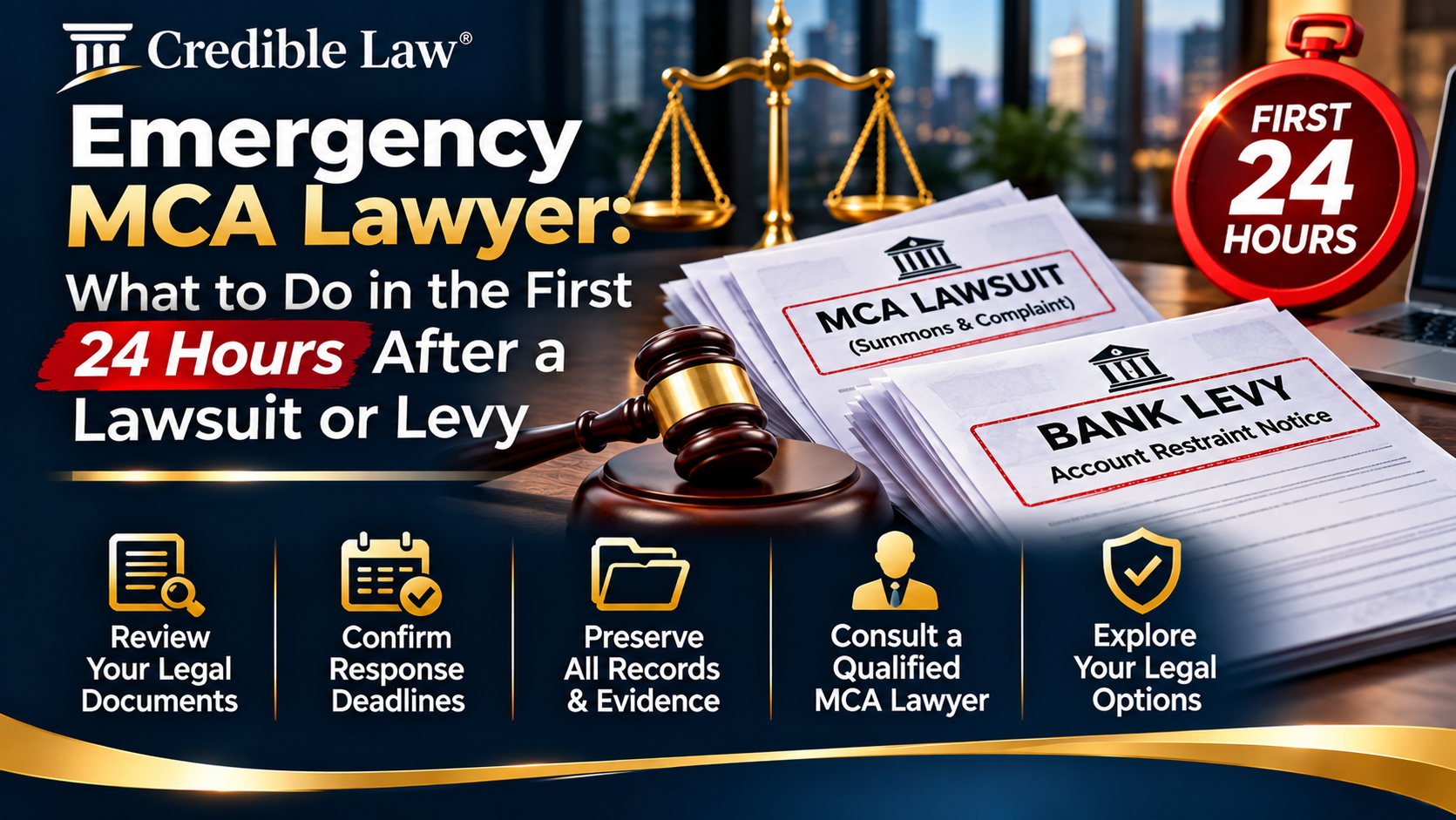
Credible Law outlines urgent steps for business owners facing merchant cash advance lawsuits, frozen business bank accounts, default judgments, and creditor enforcement, including how to identify legal deadlines and seek qualified MCA defense counsel.
San Diego, California / 500NewsWire / November 21, 2026 — A business owner receives a merchant cash advance lawsuit on Friday afternoon. Another discovers that the company's operating account has been restrained just days before payroll. A third learns that a funding company obtained a default judgment and may be pursuing business assets.
In each situation, the financial consequences can escalate quickly.
For business owners searching for an emergency MCA lawyer, the immediate concern is often whether legal action can prevent further disruption, preserve available defenses, or address an existing bank restraint.
Credible Law, a national legal information and attorney referral resource, is highlighting the first steps businesses should consider during the initial 24 hours after receiving a merchant cash advance lawsuit, bank levy, restraining notice, or judgment enforcement document.
Merchant cash advance disputes can involve complex contractual provisions, personal guarantees, recurring ACH withdrawals, UCC security interests, and litigation in jurisdictions outside the business's home state.
However, a default notice, lawsuit, judgment, and bank levy are legally distinct events. Each requires a different response.
A business owner who understands which event has occurred may be better positioned to identify applicable deadlines, preserve evidence, and obtain appropriate legal assistance.
When Do You Need an Emergency MCA Lawyer?
An emergency MCA lawyer is an attorney who can evaluate urgent legal problems involving merchant cash advance agreements and associated creditor enforcement.
Business owners may need prompt legal review when they encounter:
- A newly served merchant cash advance summons or complaint.
- A business bank account restraint or levy.
- A default judgment entered after an unanswered lawsuit.
- A creditor's attempt to enforce a personal guarantee.
- An imminent court hearing or filing deadline.
- A restraining notice affecting operating funds.
- A disputed creditor demand involving business receivables.
- Multiple MCA lawsuits or simultaneous enforcement actions.
Not every MCA default requires emergency litigation.
Some payment disputes may be addressed through contract review, reconciliation requests, or negotiated arrangements.
However, once formal legal proceedings begin, procedural deadlines and the applicable jurisdiction can substantially affect available options.
An attorney may help determine whether an answer, motion, application for relief, negotiation, or another response is appropriate.
No attorney can guarantee that a lawsuit will be dismissed, a judgment vacated, or frozen funds released.
First 24 Hours After an MCA Lawsuit or Bank Levy: An Emergency Response Checklist
Hour 0–2: Identify Exactly What Happened
The first step is determining whether the business has received a contractual notice or a formal legal document.
A funding company may send a demand letter threatening litigation. That is different from a summons issued in a filed court action.
Likewise, a bank's refusal to process withdrawals may arise from a judicial restraint, a compliance hold, an ACH issue, or another banking restriction.
Business owners should identify:
- The name of the funding company or creditor.
- The court and case number, if litigation exists.
- The date and method of service.
- The type of document received.
- The amount claimed.
- The deadline or hearing date identified.
- The bank or financial institution involved.
- Any judgment, levy, or restraining notice referenced.
These details can determine the urgency and type of legal response required.
Hour 2–4: Preserve Every Legal Document
Business owners should immediately preserve the summons, complaint, court notices, judgment documents, bank communications, and creditor correspondence.
The original MCA agreement and related records are equally important.
Relevant documents may include:
- Merchant cash advance agreements and amendments.
- ACH authorizations and payment schedules.
- Funding confirmations and repayment histories.
- Business bank statements.
- Reconciliation requests.
- Default notices and collection letters.
- Personal guarantees.
- UCC financing statements.
- Settlement correspondence.
- Prior court filings.
Electronic documents should be preserved in their original form when possible.
Businesses should avoid deleting communications, altering records, or making unsupported statements concerning the disputed obligation.
Hour 4–6: Confirm the Lawsuit Response Deadline
A merchant cash advance lawsuit creates formal procedural obligations.
The deadline for responding depends on the court, jurisdiction, method of service, and type of proceeding.
In New York, many civil actions require a response within 20 or 30 days, depending on how and where service occurred.
In California, an ordinary civil complaint generally requires a response within 30 days after service, subject to exceptions.
Other jurisdictions may establish different deadlines or require an appearance on a specified date.
These examples are not universal rules.
Business owners should follow the actual summons and obtain legal guidance concerning the applicable deadline.
Failing to respond can result in a default judgment, potentially allowing the creditor to pursue additional enforcement remedies.
Informal discussions with a creditor do not automatically extend a court deadline.
Hour 6–8: Determine Whether the Bank Account Is Legally Restrained
When a business bank account becomes inaccessible, the owner should contact the bank's legal processing or appropriate account operations department.
The objective is to determine the source and scope of the restriction.
Important questions include:
- Is the account subject to a court order or restraining notice?
- Has a judgment creditor served a levy?
- Is the restriction imposed by the bank independently?
- Is the entire account affected or only a specified amount?
- What court or creditor is identified?
- What documents can the bank provide?
- What process is required to release funds?
A merchant cash advance provider cannot ordinarily impose a judicial bank levy simply by declaring a contract in default.
However, creditors may have legally available remedies, and certain secured-creditor arrangements or prejudgment procedures may operate differently.
An attorney can evaluate the specific legal basis for the restriction.
Hour 8–12: Review the MCA Contract and Claimed Default
Merchant cash advance agreements may contain provisions addressing reconciliation, default, acceleration, security interests, personal guarantees, jurisdiction, and dispute resolution.
The agreement should be reviewed alongside the creditor's allegations.
Questions may include whether the business actually violated a contractual obligation, whether required notices were provided, and whether the claimed amount reflects the payment history.
Some MCA agreements provide mechanisms for adjusting remittances when actual business revenue declines.
The availability and effect of reconciliation depend on the contract and governing law.
A business should not assume that reduced revenue automatically eliminates its obligations.
Likewise, a creditor's declaration of default does not automatically establish that every claimed remedy is enforceable.
Hour 12–18: Identify the Proper Attorney and Jurisdiction
A business owner searching for an emergency MCA lawyer should determine where legal representation is needed.
Some merchant cash advance agreements contain New York forum-selection clauses even when the business operates in California, Florida, Texas, Illinois, or another state.
A lawsuit filed in New York may require an attorney admitted to practice in the relevant New York court.
If enforcement affects a bank account or property in another jurisdiction, additional local counsel may be appropriate.
Business owners should confirm the attorney's licensing, experience with commercial funding disputes, ability to handle the relevant proceeding, and fee arrangements.
Credible Law provides educational information and attorney referral options for businesses seeking an emergency MCA lawyer near them when facing lawsuits, creditor enforcement, or urgent contract disputes.
The appropriate attorney is not necessarily the geographically closest lawyer. The attorney must be qualified to address the relevant legal issue and jurisdiction.
Hour 18–24: Evaluate the Available Legal Response
After identifying the documents, deadlines, and applicable law, qualified counsel may evaluate potential responses.
Depending on the circumstances, these may include:
- Filing a timely answer or appropriate motion.
- Challenging service or jurisdiction when legally supported.
- Evaluating a request to vacate a default judgment.
- Seeking modification or release of a restraint.
- Reviewing a creditor's claimed balance.
- Negotiating a documented resolution.
- Assessing the enforceability of contractual provisions.
- Coordinating with appropriately licensed local counsel.
The correct response depends on the case.
Some matters require action well before the end of a 24-hour period, particularly when a hearing or deadline is imminent.
The first-day checklist is intended to help business owners organize an urgent response, not to suggest that legal action can safely be delayed.
Can an Emergency MCA Lawyer Stop a Business Bank Levy?
An attorney may be able to evaluate and pursue legal remedies concerning a bank levy or restraint.
However, the existence of a bank restriction does not automatically mean that the creditor acted improperly.
A lawful judgment creditor may have authority to restrain or levy eligible funds after satisfying applicable requirements.
Potential issues for legal review include whether the judgment is enforceable, whether the proper debtor was identified, whether the bank received valid legal process, and whether applicable exemptions or procedural objections exist.
In New York, restraining notices may be governed by CPLR Section 5222.
Other states have different procedures governing garnishments, bank levies, and judgment enforcement.
A business owner should not assume that consumer exemptions apply to ordinary business operating funds.
Likewise, the fact that payroll is approaching does not automatically require a bank or court to release restrained funds.
An emergency MCA attorney may assess whether expedited relief is available, but no particular result is guaranteed.
Emergency MCA Lawyer vs. Merchant Cash Advance Debt Settlement Company
Business owners seeking urgent help may encounter attorneys, debt settlement companies, financial consultants, and referral networks.
These organizations provide different services.
A licensed attorney may provide legal advice, represent a client in authorized proceedings, and evaluate litigation defenses.
A debt settlement company may negotiate with creditors but cannot provide legal representation merely by offering debt relief.
An attorney referral network may help businesses locate independent legal professionals.
Credible Law operates as a legal information and attorney referral resource, not as a law firm.
Business owners should verify the qualifications and licensing of any attorney before engaging legal representation.
They should also ask whether the attorney will personally handle the matter, whether local counsel is required, and what services are included in the proposed fee.
What If the MCA Company Already Obtained a Default Judgment?
A default judgment may be entered when a defendant fails to respond or otherwise comply with applicable court requirements.
Once entered, a judgment may permit the creditor to pursue enforcement remedies.
However, depending on the jurisdiction and facts, an attorney may evaluate whether grounds exist to seek relief from the judgment.
Potential issues may include improper service, procedural defects, excusable default, a potentially meritorious defense, or other legally recognized grounds.
Different courts apply different standards and deadlines.
A default judgment is not automatically invalid merely because the business owner did not know about the lawsuit.
Similarly, a business should not assume that an unfavorable judgment can always be reopened.
Prompt legal review is particularly important when enforcement has already begun.
Can an MCA Lender Sue a Business in Another State?
Potentially.
Some merchant cash advance agreements contain forum-selection and choice-of-law provisions.
These provisions may identify the jurisdiction where disputes will be litigated and the law intended to govern the agreement.
Their enforceability depends on the contract and applicable law.
For example, a business operating in Florida may face litigation in New York under a contractual forum-selection provision.
The business may need to respond in the selected jurisdiction even if its operations and bank accounts are located elsewhere.
An emergency MCA lawyer should evaluate the forum-selection clause, service of process, jurisdictional requirements, and any applicable objections.
A business should not ignore out-of-state court papers simply because the funder is located elsewhere.
Can an MCA Attorney Challenge the Agreement Itself?
In some circumstances, an attorney may examine whether the agreement is enforceable as written.
Merchant cash advances are frequently structured as purchases of future receivables.
Courts may evaluate the substance of the transaction when determining whether it is a genuine receivables purchase or should be treated as a loan.
Relevant issues may include reconciliation rights, allocation of repayment risk, default provisions, and the circumstances under which repayment becomes due.
However, an MCA agreement is not automatically invalid because its financing cost is high or because the business is experiencing financial hardship.
The applicable legal analysis depends on the transaction and jurisdiction.
Attorneys may also evaluate claims involving breach of contract, disputed balances, personal guarantees, or improper enforcement procedures.
What If Multiple MCA Companies Are Suing the Same Business?
Businesses with stacked merchant cash advances may face multiple collection demands or lawsuits simultaneously.
Each funder may assert separate contractual obligations, security interests, guarantees, or enforcement rights.
This can create overlapping deadlines and competing demands against limited operating funds.
A business owner should prepare a complete list of funders, claimed balances, payment histories, pending lawsuits, judgments, and security interests.
Counsel may need to evaluate each agreement independently while considering the overall financial condition of the business.
In some circumstances, commercial restructuring or bankruptcy counsel may also be appropriate.
The availability of any restructuring option depends on the business's circumstances and applicable law.
What Should Business Owners Avoid After Receiving an MCA Lawsuit?
An urgent legal dispute can lead to decisions that create additional exposure.
Business owners should avoid ignoring court papers, missing deadlines, signing settlement agreements without understanding their terms, or making inaccurate statements about assets and payment history.
They should not conceal collateral, transfer restricted funds to evade lawful enforcement, or disregard a court order.
Stopping ACH payments without reviewing the agreement may also create additional contractual issues.
The safer approach is to preserve records, identify the applicable legal process, and obtain qualified guidance before taking action that may affect creditor rights.
How to Choose an Emergency MCA Lawyer
Business owners evaluating legal assistance should consider the attorney's experience with merchant cash advance litigation, commercial contracts, creditor enforcement, and the jurisdiction involved.
Relevant questions include:
- Are you licensed to practice in the court where my lawsuit is pending?
- Have you handled merchant cash advance contract disputes?
- Can you review my summons and identify the applicable response deadline?
- Do you handle bank levies, restraining notices, and judgment enforcement?
- Will you personally represent the business, or will another attorney handle the case?
- What are the fees and scope of representation?
- What immediate actions, if any, are legally appropriate?
A qualified attorney should be able to explain the available options and their limitations without guaranteeing dismissal, settlement, or release of funds.
Credible Law provides additional information about merchant cash advance defense attorneys and legal options for businesses facing MCA lawsuits, collection disputes, contract enforcement, and related legal concerns.
Frequently Asked Questions About Emergency MCA Lawyers
How quickly should I contact an emergency MCA lawyer?
As soon as possible after receiving a lawsuit, court order, bank levy, or other time-sensitive enforcement document. The appropriate response depends on the legal deadlines and circumstances.
Can an emergency MCA lawyer stop a lawsuit immediately?
An attorney may evaluate available defenses, procedural motions, negotiations, or other legal responses. Representation does not automatically stop litigation or guarantee dismissal.
Can an MCA company freeze my business bank account without a judgment?
An ordinary post-judgment levy generally requires a judgment and applicable legal process. Other restrictions, including certain prejudgment remedies, secured-creditor arrangements, or bank-initiated holds, may follow different rules.
What happens if I ignore an MCA summons?
Failing to respond can result in a default judgment and potential enforcement against eligible business assets or other property for which the defendant is legally liable.
Can an MCA lawyer help if a judgment has already been entered?
Potentially. An attorney may evaluate whether grounds exist to challenge the judgment or address enforcement. Available remedies and deadlines vary.
Can an MCA lawyer help negotiate a settlement?
Yes. An attorney may assist with negotiations when appropriate. Whether a creditor agrees to settle depends on the circumstances, and no settlement outcome is guaranteed.
Do I need a New York attorney if my MCA lawsuit was filed in New York?
You generally need counsel authorized to represent you in the relevant New York court, subject to applicable rules governing appearances and admission. An attorney licensed only in another state may not be able to appear without additional authorization.
Is Credible Law an emergency MCA law firm?
No. Credible Law is a legal information and attorney referral resource. When available, legal representation is provided by appropriately licensed independent attorneys.
Can an MCA lawyer help with multiple funders?
An attorney may evaluate disputes involving several MCA agreements, overlapping collection actions, and competing creditor claims. The scope of representation should be confirmed directly with counsel.
Credible Law Encourages Immediate Review of MCA Lawsuits and Bank Restraints
A merchant cash advance lawsuit or bank levy can create serious financial pressure when a business is already struggling to meet payroll, vendor obligations, or other operating expenses.
However, the legal response depends on the exact documents received, the applicable jurisdiction, and the rights and obligations established by the agreement.
The first 24 hours should focus on identifying the legal event, preserving records, confirming deadlines, and obtaining appropriate assistance.
Business owners should not assume that a collection demand is equivalent to a judgment or that every bank restriction can be resolved through the same procedure.
Early legal review may help identify available defenses, procedural options, and potential negotiated resolutions before additional consequences arise.
Served with an MCA lawsuit or facing a business bank levy? Call Credible Law at (888) 201-0441 to discuss available legal information and attorney referral options.
About Credible Law
Credible Law is a national legal information and attorney referral resource helping individuals and businesses access educational information about legal disputes and available legal assistance.
Its business-related resources address merchant cash advance agreements, commercial funding disputes, MCA lawsuits, creditor collection activity, UCC filings, bank levies, and related legal concerns.
Credible Law is not a law firm and does not itself provide legal representation. When available, legal services are provided by appropriately licensed independent attorneys. Contacting Credible Law does not establish an attorney-client relationship.
Media Contact
Credible Law
San Diego, California
Phone: (888) 201-0441
Website: https://crediblelaw.com/
Business and Legal Information Inquiries
Legal Disclaimer: This press release is provided for general educational and informational purposes only and does not constitute legal advice. Litigation deadlines, merchant cash advance agreements, creditor remedies, and available defenses vary by jurisdiction. Business owners should consult qualified legal counsel regarding their individual circumstances.